crisis_alert
Situation
A 3,420 sq mi watershed drains through seven tributaries into shallow Dauphin Lake, feeding five beach communities, farmland, and a fishery. The 2011 flood (lake at 860.76 ft) is living memory, and 2026 opened with the highest snowpack in the record. The only official picture was provincial PDF outlooks and raw federal gauge data no resident reads. The problem wasn't building a dashboard — it was turning existing data into something a property owner could act on, in a season that looked like it might rival 2011.
lightbulb
Decision
Trust authoritative instrument data and degrade gracefully — if the live API drops, show verified readings and point to the official source rather than break. Watch the leading indicator (seven tributaries, converted to a projected rate of change) instead of the lagging lake. Forecast in four probability bands tied to actions, and revise publicly as conditions change. Complement the province, never impersonate it. Hold the scope to monitoring and lock both domains. Rejected: single-source feeds, a lone lake-level readout, deterministic predictions, and "all things Dauphin Lake" scope.
shield
Risk
Reliability through a storm's network stress (designed-in fallback); accuracy with honest uncertainty (probability bands, an explicit wind caveat, the not-official disclaimer); graduated action guidance so the tool neither cries wolf nor under-warns; zero-cost durability so it can't die from a hosting bill.
check_circle
Change
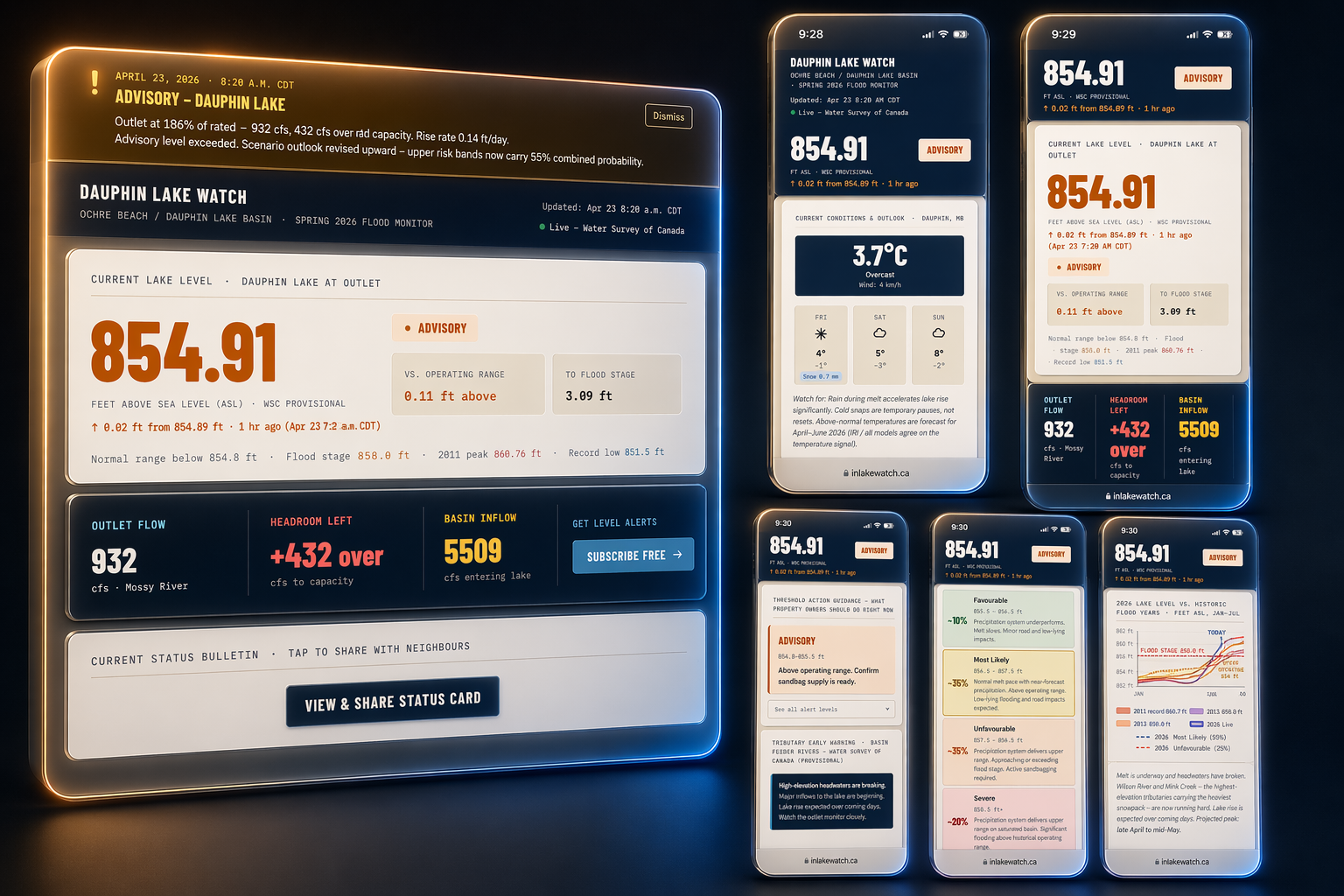
A watershed with no independent monitor now has one place turning federal data into plain-language, action-tied guidance, refreshed every 15 minutes against the 2011/2013/2014 record. Through a record snowpack, the basin was handled and the lake never reached the most-likely peak band — and the tool made that calm legible in real time. Good judgment here looks like nothing happening; the tool made the "nothing happened" visible.
System Architecture
Real-time hydrological monitoring integrating federal gauge data with community-focused alerts. Built for speed and reliability during active flood conditions.
account_tree
Data Flow
1
Water Survey of Canada gauges (9 stations)
Real-time measurements across lake and tributaries
2
Environment Canada OGC API
15-minute update intervals, JSON data format
3
Dashboard processing engine
React frontend, real-time data parsing and visualization
4
Threshold monitoring system
Color-coded status: Normal → Advisory → Flood Stage
5
Alert distribution
Email and SMS notifications when thresholds crossed
6
Community access
Free public dashboard, no accounts required
show_chart
Frontend Dashboard
- React real-time visualization
- 7-day hydrograph with trend lines
- Responsive design for mobile alerts
- Color-coded threshold indicators
cloud
Data Integration
- Environment Canada OGC API
- Water Survey of Canada gauges
- 15-minute real-time updates
- Weather context integration
notifications_active
Alert Infrastructure
- Email and SMS notification system
- Threshold-based triggers
- Subscriber management
- Emergency broadcast capability
public
Deployment
- Netlify hosting with CDN
- GitHub version control
- Auto-deployment pipeline
- Live at dauphinlakewatch.ca
Monitoring Network
9 WSC stations across Dauphin Lake watershed providing comprehensive basin coverage:
05LJ009 (Lake Level)
05LJ007 (Turtle River)
05LJ012 (Wilson River)
05LJ005 (Vermillion River)
05LJ045 (Valley River)
05LJ010 (Mink Creek)
05LJ019 (Mossy River North)
05LJ027 (East Mossy River)
05LJ025 (Mossy River Outlet)
05LH001 (Red Deer River)
05LH005 (Ochre River)